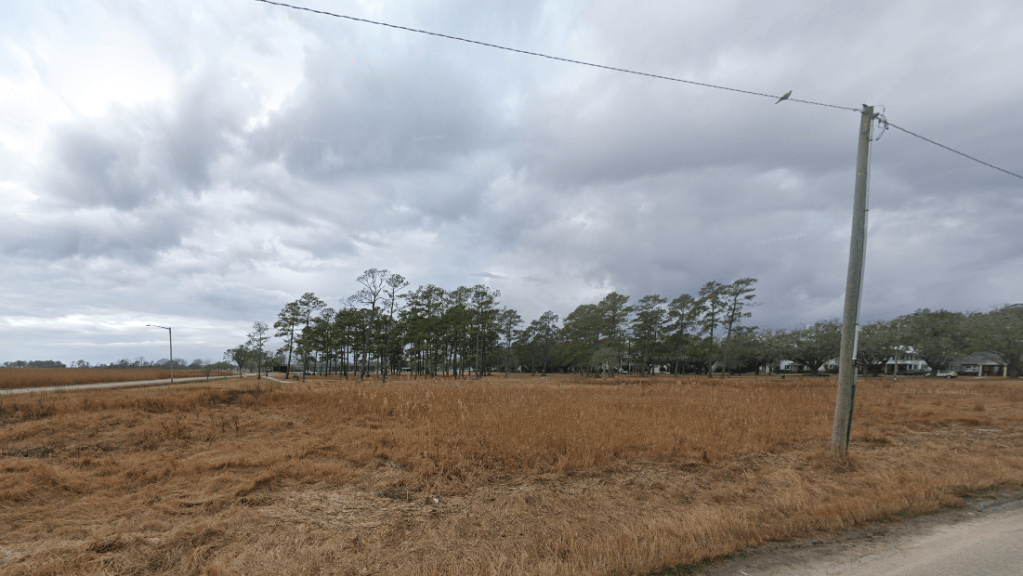
The inverse condemnation case law in South Carolina is replete with flooding issues and the state just got another (unpublished) decision by the S.C. Court of Appeals on the matter: Christmas v. County of Georgetown, No. 2026-UP-423 (S.C. Ct. App. August 19, 2026).
In Christmas, the Court of Appeals addressed claims arising from flooding caused by improvements to Georgetown’s East Bay Park (pictured above in 2023). The project included raising and expanding tennis courts, adding a paved walking path, and other improvements. The plaintiff alleged those changes, together with deficiencies in the surrounding drainage system and roadway, increased flooding onto his nearby property and caused damage. He unsurprisingly asserted claims against Georgetown County, the City of Georgetown, and SCDOT for, inter alia, negligence, violation of section 5-31-450 of the South Carolina Code, a writ of mandamus, and inverse condemnation.
The trial court granted directed verdicts to the County, City, and SCDOT on the plaintiff’s causes of action listed above. The plaintiff appealed that decision and further argued the trial court erred in restricting his expert witness’s qualifications and in limiting his expert’s testimony (as well as his own testimony).
I won’t recite all of the facts and holdings of the case. That’s what the opinion is for. But ultimately, the S.C. Court of Appeals affirmed the lower court’s order with some modifications.
There are two things I’d like to note, however: (1) the court’s application of Marlowe v. SCDOT on the expert evidentiary issues; and (2) the court’s failure to recite the proper test for inverse condemnation.
The Court’s Application of Marlowe
The Court of Appeals upheld the trial court’s refusal to allow the plaintiff’s expert to give certain hydrology and causation opinions. This was an unsurprising holding: the plaintiff had not qualified him as a hydrologist, and the court concluded the expert could not simply relay hydrological analysis performed by another expert (who had been retained by a settling defendant).
The court also upheld the trial court’s decision that the expert could not opine that the trucks used to renovate the park caused the subsidence at issue (because he had not provided evidence showing same), only allowing him to opine that heavy trucks could cause subsidence of the road generally.
Because the plaintiff could not rely upon the deficiencies in the surrounding drainage system and roadway as “affirmative acts” required to support an inverse condemnation claim,1 he had to point to the construction project (e.g., the elevation of the tennis courts) as the affirmative act. This is assuredly an affirmative act.2 But the plaintiff’s expert’s generalized opinion did not support a finding that the affirmative act caused the damage to the plaintiff’s property—another requirement of inverse condemnation law.3
In affirming the trial court’s decision, the Court of Appeals relied upon Marlowe v. S.C. Dep’t of Transp., 446 S.C. 309, 317, 919 S.E.2d 553, 557 (2025) where the S.C. Supreme Court held that “before expert testimony is admissible upon the question of the causal connection between plaintiff’s injuries and the acts of the defendant, the testimony must satisfy the ‘most probably’ rule.” Because, as in Marlowe, the plaintiff’s expert “did not rise above speculation,” the claim had to fail.4 This is, to my knowledge, the first application of Marlowe on this issue since that case’s publication.
For The Last Time (Who Am I Kidding) Permanence Is Not A Requirement For Inverse Condemnation
Finally, I have to gripe. The S.C. Court of Appeals committed a common error when it recited the rule for inverse condemnation as: “To establish an inverse condemnation, a plaintiff must show: (1) an affirmative, positive, aggressive act on the part of the governmental agency; (2) a taking; (3) the taking is for public use; and (4) the taking has some degree of permanence.”5 In 2005, the S.C. Supreme Court expressly removed permanence as an element of inverse condemnation because temporary takings are a thing.6 Nonetheless, this “permanence” language keeps finding itself copy-and-pasted into court opinions (not that it matters in this instance). One day, I’ll stop being tormented by this issue.
Footnotes
- See Hawkins v. City of Greenville, 358 S.C. 280, 293, 594 S.E.2d 557, 564 (Ct. App. 2004). ↩︎
- See McGann v. Mungo, 287 S.C. 561, 572(S.C. App. 1985). ↩︎
- See id. ↩︎
- Christmas v. County of Georgetown, No. 2026-UP-423, at 9 (S.C. Ct. App. August 19, 2026). ↩︎
- Id. at 8 (citing Hawkins, supra). ↩︎
- Byrd v. City of Hartsville, 365 S.C. 650, 657, 620 S.E.2d 76, 79 (2005) ↩︎


Leave a Reply